
Ranked-choice voting (RCV) is a simple improvement to our current voting system that delivers several benefits to voters. Instead of being limited to picking just one candidate, with ranked-choice voting you have the option to rank your backup choices (2nd choice, 3rd choice, etc) in case your first choice can’t win.
Where ranked-choice voting has been adopted, it consistently produces the following civic benefits:
Where is RCV used?
RCV is the fastest growing nonpartisan election reform movement in the United States today. Originally invented in the 1850’s, it is currently used in two states (Alaska and Maine), over 50 cities and counties across the United States (including Seattle starting in 2027), and several other countries (Australia, Ireland, and others).
How does Ranked-choice Voting work?
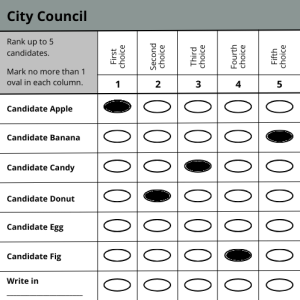
With RCV, you have the option to rank candidates in the order you prefer. In the sample below, the voter picked “Apple” as their 1st choice, “Donut” as their 2nd, “Candy” as their 3rd, etc.
How are ballots counted (Single-winner contests)?
For single winner contests (like Mayor, Governor, County Executive, etc.), Ranked-choice Voting, also called “Instant Runoff Voting”, ensures majority support. A candidate who gets more than 50% of the first choice votes wins, just like in any other election. But if no candidate gets more than half the votes, an instant runoff follows. The candidate with the fewest first-choice votes is eliminated, and voters who picked that candidate first have their ballot count for their next choice. This process repeats until one candidate receives more than 50% of the votes.
A recent Sightline Institute report further details how each current county council district contains a mix of Democratic and Republican voters; it includes maps of precinct-level partisan results within each district.
How are ballots counted (Multiple winner contests)?
Ranked-choice voting can also be used to elect several winners in one contest, for example to pick the top three winners to fill three open seats on a school board. In multiple winner elections Ranked-choice voting, also called “Proportional RCV” or “Single Transferable Vote”, works much like single-winner RCV but includes a reallocation of surplus votes beyond what is needed for a candidate to win. For example, in a three-winner race, each candidate needs just over 25% of votes to win (25% + 1). Once a candidate reaches that winning threshold, they are elected. Any additional votes they get are not “wasted” – instead, they count for those voters’ backup choices. A more detailed description can be found here, and a short explainer video here.
It is important to note that the experience for a voter is identical for single winner and multiple winner contests. The only differences are how votes are counted. All election technology providers (the computer systems that count ballots) can support both single and multiple winner contests.
What’s so interesting about multiple winner contests?
Multiple winner contests that use “Proportional Ranked-Choice Voting” provide a unique benefit not usually found in US politics: Proportional Representation. Multiple representatives are elected in proportion to the number of people who vote for them.
For example, consider a town with 3 open seats on the school board in a town where 65% of the voters support one political party (Salmon) and 35% support another party (Seals). Under our current plurality “winner-take-all” system, each seat is filled in a separate contest. Salmon party voters have 65% of the votes which is enough to win all 3 seats. Seal voters get no representation. Contrast this with Proportional RCV, where Salmon party voters have the power to elect 65% of the seats, but not all of the seats. And Seal party voters have the power to elect 35% of the seats.
Ranked-choice Voting in Washington State
RCV is not currently used for any public elections in Washington. However, Seattle voters recently adopted it and will begin using RCV in the 2027 primary for all city offices. Under current Washington State law, only “charter” (aka “first class”) cities and counties may choose to modify their charters to adopt ranked-choice voting, as Seattle has done. There are presently 10 charter cities and 7 charter counties in Washington – Snohomish being one. (A “charter” is similar to having a local “constitution” that covers aspects of city or county government.)
If a non-charter city or county wishes to adopt RCV, it would either need to await passage of the pending legislation known as the VOICES Act (HB 1448), or it could pursue implementation under the Washington Voting Rights Act.
How do Proportional Ranked-Choice Voting elections work, from a voter’s point of view?
When ranked-choice voting is used to elect multiple candidates at the same time, it can also be called “Single Transferable Vote.” Voters can rank all the candidates in their district in order of preference, or just rank one if they choose. If a candidate doesn’t have enough votes to pass the threshold and win a seat, that candidate is eliminated and each voter’s vote for that candidate moves to their second choice, and so on. Similarly, if a candidate wins a seat with more votes than they need, a portion of the candidate’s excess votes move to second choice candidates on those ballots. In this way, the results are proportional to the votes in the electorate, but from the voter’s point of view, all they have to do is vote their true preferences and know that their vote will help elect someone who represents them.
Ranked-choice Voting in Snohomish County
Snohomish is a charter county, with the ability to adopt RCV when approved by Snohomish County Voters. Amendments to the County Charter may be submitted to voters in one of three possible ways:
How could RCV benefit Snohomish County?
Several problems with Snohomish County elections call out for attention:
Let’s explore each problem in more detail.
Learn more about single-winner Ranked-Choice Voting:
What is Block Voting, and what’s the problem with it?
Block voting is how the County currently elects charter review commissioners, where each voter gets 3 votes and there are 3 winners for a single contest. While block voting may appear simple and efficient it systematically disadvantages minority communities, stifles political diversity, and undermines core democratic principles.
The underlying problem is easy to describe: Block Voting allows a bare majority (e.g. 51%) of like-minded voters to elect all of the winners. This problem with block voting was so severe that it was made illegal for federal congressional districts by the Apportionment Act of 1967.
Empirical research, court decisions, and historical outcomes all converge on one conclusion: block voting is inherently flawed and should be replaced with more representative alternatives. Learn more here in: The Case Against Block Voting: Undermining Democracy and Representation.
How Has Block Voting Worked for Snohomish County Charter Review Contests?
The impact of using Block Voting whenever a large number of candidates run is that the winning candidates do not have broad voter support. Analysis shows that in both the 2015 and 2025 Charter Review Commission elections, 14 of the 15 winning candidates earned less than 20% voter support (some with as little as 10% support).
For matters as vital as ensuring the county charter meets the current need of citizens, requiring that the Charter Review Commission reflect the intents of a true majority of voters is paramount.
Can RCV Improve Representation for Snohomish County Charter Review Contests?
Yes! RCV ensures that winners have real, broad support, so our elected Charter Review Commissioners reflect the range of perspectives and priorities across the county. Compared to the current Block Voting method that systematically shuts out minority views, stifles political diversity, and undermines core democratic principles, adopting RCV would be a significant improvement.
Elections for Snohomish County offices: Neither Active nor Competitive
Each of our County Council districts contains a wide variety of political views. Some districts are strongly liberal or strongly conservative, some are equally divided—but none of them are politically homogeneous. Given this significant variation in perspectives, there is no way that a single elected official can represent all the views of his or her constituents.
It’s enlightening to examine elections for Snohomish County offices to see how active they are and how well they reflect the diverse needs of the people. Going back to 2013, several facts indicate that elections for Snohomish County Councilmembers are neither active nor competitive:
These facts raise several questions about the possibility of better solutions. There are proven ways to make elections more competitive and elect representatives such that everyone in all districts has a reasonable chance of electing a councilmember who represents their views.
Can RCV Improve Engagement and Representation for Snohomish County Contests?
During the 2016 Snohomish County Charter Review Commission meetings, concerns were raised that people living in the rural parts of the county felt that county government was not responsive to their needs. A Charter Amendment was discussed that would have increased the size of the county council in order to address this concern, but ultimately it did not advance. As a result, concerns remain about how we can ensure fair representation for ALL citizens of Snohomish County
Considering the concerns over rural representation, and the fact that Snohomish County elections have been neither active nor competitive for over a decade, it’s evident that we can do better!
Snohomish County could adopt a system of proportional representation for County Council (using ranked-choice voting), addressing all of the above concerns.
Rather than five districts each electing a single councilmember to the County Council, there could instead be three districts, each electing three representatives, using Ranked-choice Voting, to achieve proportional representation.
Benefits of this approach include:
Why make a change?
Let’s review the key points made earlier:
Block Voting has been widely discredited and outlawed federally for almost 60 years. For Snohomish County Charter Review Commission elections, it produces winners that almost always have less than 20% support from the public. With the use of Ranked-choice Voting, Snohomish County can see the election of Charter Review Commissioners with wider public support.
Snohomish County Council elections have not been active or competitive for over a decade. Concerns about fair representation for all Snohomish County citizens was originally noted a decade ago and has still not been addressed. What can be done to address these issues? RCV has been shown to consistently result in increased candidates and voter participation.
Ranked-choice voting is the fastest growing nonpartisan election reform movement in the United States today. It doesn’t provide a bias for any single political party, and is based on the premise that fair, equitable, proportional representation is necessary for a healthy democracy. RCV can help improve Snohomish County politics and government. Now is the time for change!