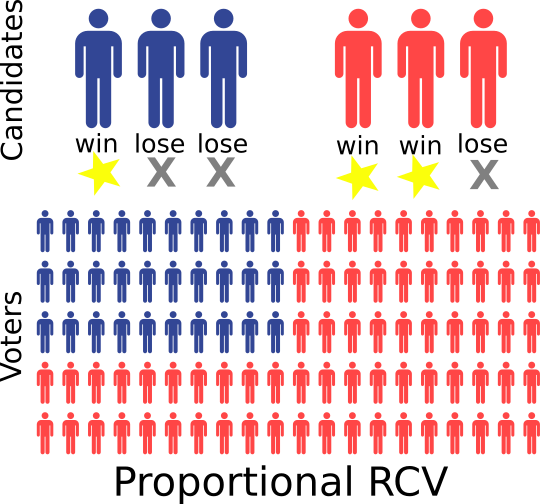
Whatcom County’s Charter Review Commission is considering charter changes to make our elections fairer and more representative. One reform that the Commission is likely to consider is Ranked-Choice Voting (RCV). The Whatcom County chapter of FairVote Washington has been actively attending this year’s Charter Review Commission meetings to advocate for RCV and explain the benefits of electoral reform to our community. (Want to get involved or learn more? Contact us!)
Whatcom County has multiple options for how to adopt Ranked-Choice Voting to improve county elections:
Click the links above to jump to each section, or scroll down to read our analysis and recommendations for each option.
Ranked-Choice Voting (RCV) gives voters the option to rank candidates in order of preference: first choice, second choice, third choice, and so on. If your first choice doesn’t have enough support to win, your vote goes to your next choice.
Here are some ways RCV would improve our elections for Whatcom County Council:
Each of our County Council districts has a wide variety of political views. Some districts are strongly liberal or strongly conservative, some are equally divided—but none of them are politically homogeneous. Given this significant internal variation in perspectives, there is no way that a single elected official could represent all the views of his or her constituents.
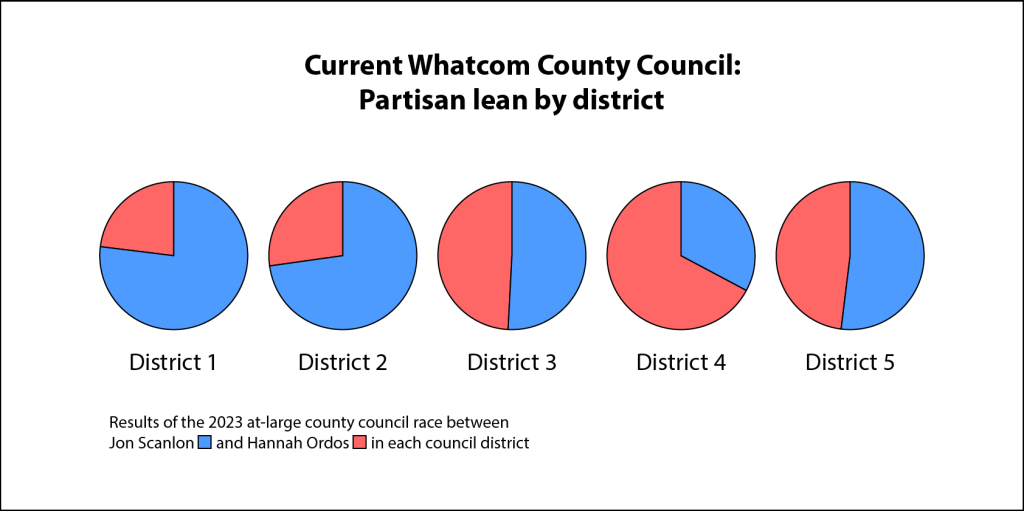
With our current method of “winner take all” elections, a significant share of the electorate in each district votes for the losing candidate. These voters, both conservatives and liberals, effectively have no one representing them. All the gray parts in the following charts are effectively wasted votes:
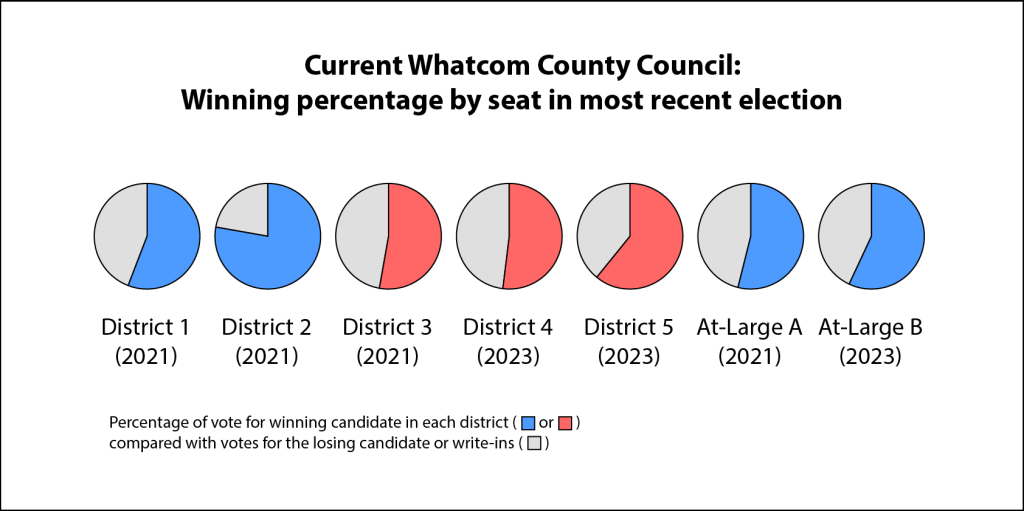
Ranked-Choice Voting for the County Council solves these problems by consolidating council districts into larger “superdistricts” that elect more than one council member at the same time, or by eliminating districts entirely and electing the whole council in one big ranked-choice election. When RCV is used in this way, it is a form of proportional representation.
Proportional RCV overcomes many of the challenges inherent to winner-take-all elections:
A recent Sightline Institute report further details how each current county council district contains a mix of Democratic and Republican voters; it includes maps of precinct-level partisan results within each district.
Let’s look at each of those scenarios in detail:
In Whatcom County, there are several ways to draw these proportional “superdistricts”. Here are some scenarios that each have their own advantages, but all of which would create a fairer and more proportional council. The blue and red circles below represent the informal party affiliation of each candidate. The projected results in Options A, B, and C were calculated from actual precinct-level vote totals from recent council elections:
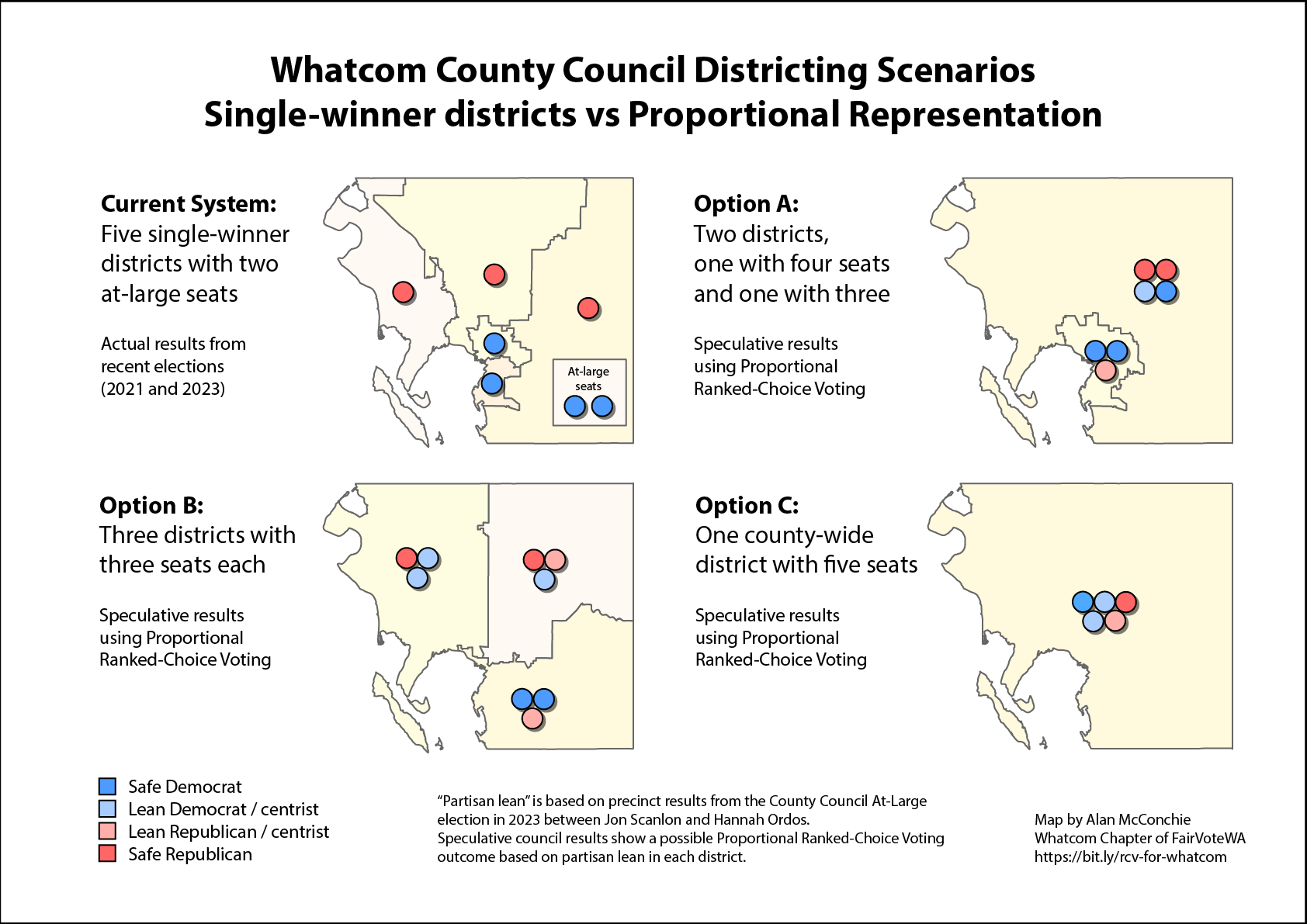
Click the tabs below to learn more about each of the three options:
How do Proportional Ranked-Choice Voting elections work, from a voter’s point of view?
When Ranked-Choice Voting is used to elect multiple candidates at the same time, it can also be called “Single Transferable Vote.” Voters can rank all the candidates in their district in order of preference, or just rank one if they choose. If a candidate doesn’t have enough votes to pass the threshold and win a seat, that candidate is eliminated and each voter’s vote for that candidate moves to their second choice, and so on. Similarly, if a candidate wins a seat with more votes than they need, a portion of the candidate’s excess votes move to second choice candidates on those ballots. In this way, the results are proportional to the votes in the electorate, but from the voter’s point of view, all they have to do is vote their true preferences and know that their vote will help elect someone who represents them.
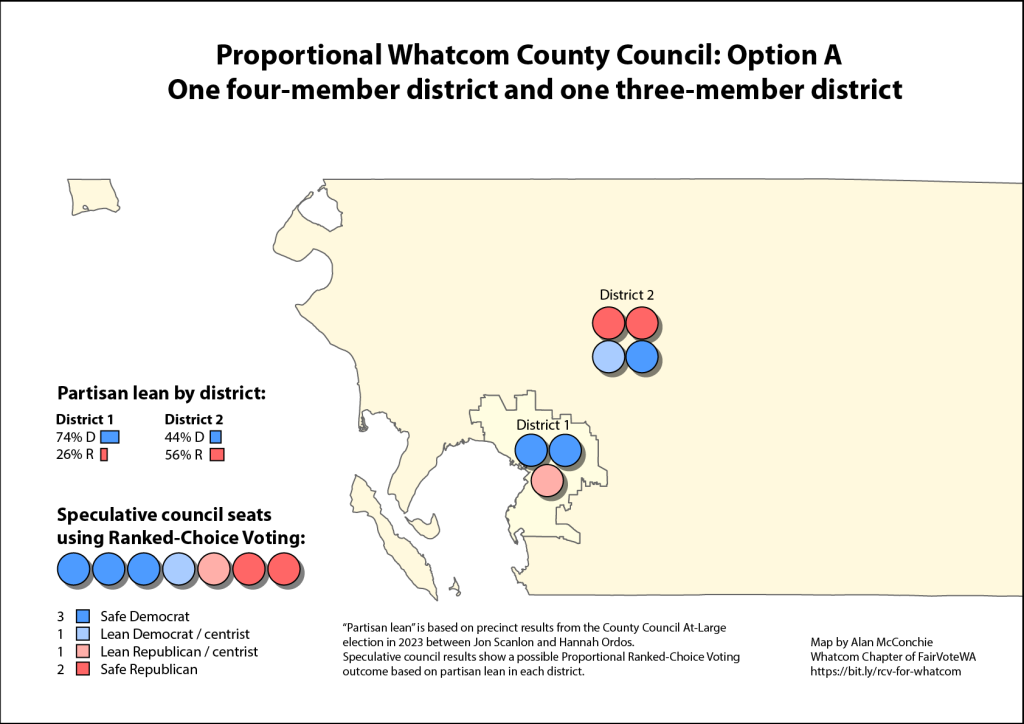
Option A: Two districts, one with 4 seats and one with 3 seatsSpeculative results:
Considerations for the “Four and Three” plan:
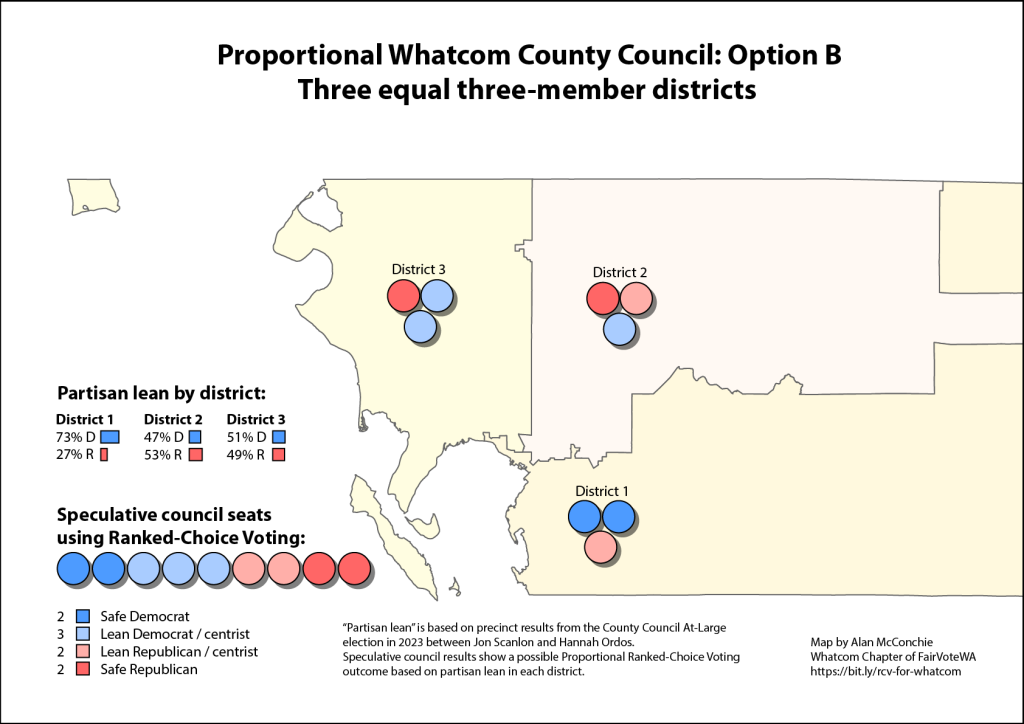
In this scenario we create three equal-population districts with three seats each. In this case, each district would have one third of the total county population. As a result of creating these equal districts, the county council would expand to nine seats from the current seven.
The three districts in this example map are the current three districts that are used for Port of Bellingham and Whatcom PUD elections. They are also very similar to the three county council districts that were in effect before 2015. Many other configurations of three districts are also possible, but the overall proportional results generally come out the same.
Speculative results:
Considerations for the “Three Times Three” plan:
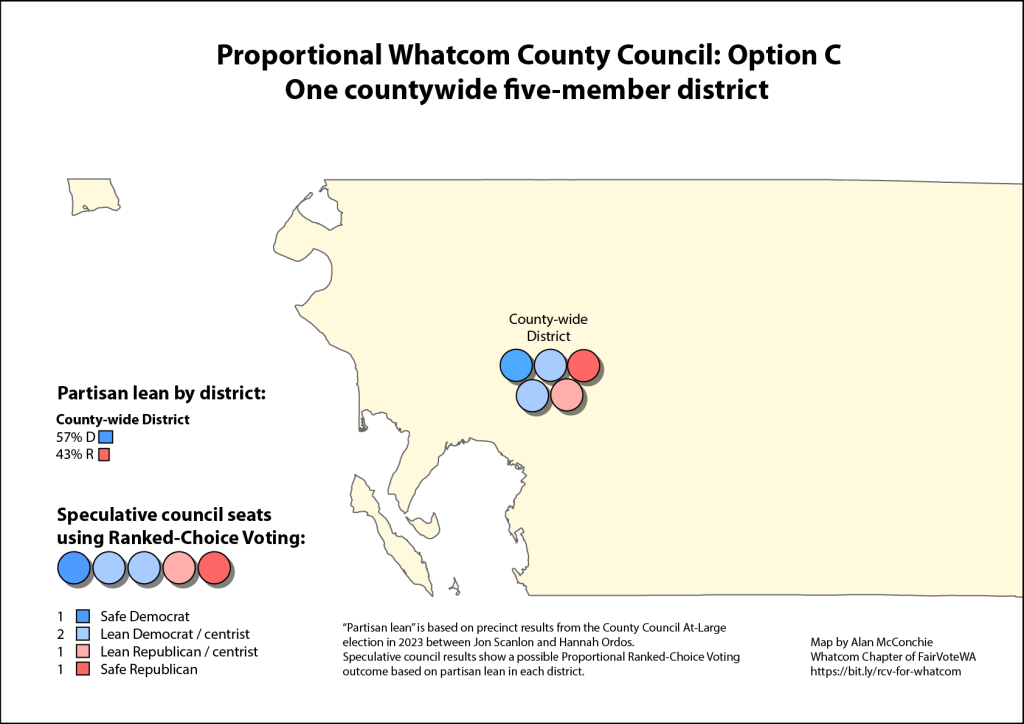
As an alternative, we could also eliminate districts entirely and elect the whole council at the same time in one Proportional RCV election.
To keep the ballot length manageable and to avoid overwhelming voters, we could reduce the county council to just five seats in this plan (although keeping 7 seats is also perfectly feasible, and in practice Cambridge, Massachusetts has no problem electing a council of 9 seats all at once in the same RCV election).
Speculative results:
Considerations with the “Five Countywide” plan:
Proportional Representation won’t tip the balance of power, it just makes every vote count
We see that in all of these examples the overall partisan split in the county council will likely narrowly favor Democrats for the foreseeable future. This is inevitable and to be expected given current demographic trends, and given recent election results in the county (typically closely contested for local races, but becoming more and heavily Democratic in our county’s votes for Governor and President).
On a superficial level, these hypothetical results look very similar to the 4-3 split on the current council. However, on a deeper level these proportional results do a much better job reflecting the true preferences of the public. More centrists will be elected under a proportional system, leading to better problem solving and collaboration across the aisle. Having some urban conservatives and rural liberals elected will also bring entirely new perspectives to the council that have not previously had a say. And even in the seats that are “safe” for each party in a proportional system, underperforming incumbents still have to win voter support to keep their seats; if voters don’t like an incumbent of their own party, they can easily vote for a new candidate with similar political views, without worrying about throwing the election to a challenger from a completely different party.
Whatcom has a unique opportunity to eliminate some primary election races. Because Whatcom is a nonpartisan charter county, we are exempt from the state law requirement that local jurisdictions hold a top-two primary where the two highest vote-getters advance to the general election.
Whatcom could eliminate the primary entirely for primary races, using RCV in the general election to pick the winner. Or more likely, we could retain the primary only when more than 5 candidates are running, and with the winner decided amongst the “final five” candidates using RCV in the general election. This “top five” system (similar to the “top four” system used in Alaska) has the same cost benefits of eliminating the primary entirely, since primary elections would be unneeded in the vast majority of cases, and it avoids overwhelming voters with too many options in the general election if a large number of candidates are in the running.
This solves several problems with our current voting system (top two):
Learn more about single-winner Ranked-Choice Voting:
Q: Would this apply to all races in Whatcom County?
Only county offices (those defined in the County Charter) would be affected by this change. Specifically: County Executive, Assessor, Auditor, Treasurer, Sheriff, and the County Council. Other elections like city council races, port commission, etc, would not be affected and would continue to use the current top two primary system.
Q. How do primary elections work with the multi-winner Ranked-Choice Voting described earlier?
In the proportional (multi-winner) implementation of RCV, there is typically no primary election. If we switch to multi-winner Ranked-Choice Voting for the county council (as described in the previous section) then all council candidates would bypass the primary election and voters would rank all candidates in their district on one ballot in the general election.
Whatcom County already has one elected body that uses multi-winner districts: the Charter Review Commission itself. However, the method used to elect charter commissioners—where each voter gets to vote for three people, and the three candidates with the most votes win, a system known as “block voting”—has flaws that would be easily remedied by Ranked-Choice Voting:
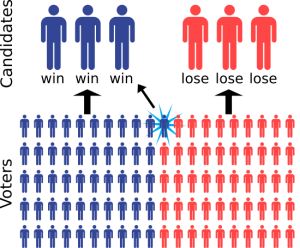
The first problem with the current method is that it is not proportional.
A slim majority of voters in a district could win all three of that district’s commission seats. We saw this happen in our 2024 Charter Review election: 4 of the 5 districts were represented 100% by candidates from the same party.
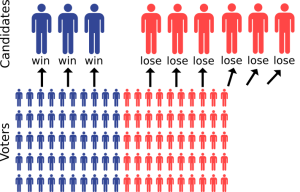
The second problem with block voting is that the number of candidates for each party can have a significant impact on the results, often leading to antidemocratic outcomes.
For example, if the majority group runs too many candidates, they could split their votes leading to a minority faction winning all the seats. This creates incentives for strong party control of who runs, and deters candidates from running. Strategic voters feel obligated to follow their party’s endorsements rather than vote their true preferences.
Both of these problems would be solved by using multi-winner Ranked-Choice Voting for the Charter Review Commission elections.
Voters could vote their true preferences, parties wouldn’t have to worry about vote splitting and perversely having worse chances of winning if more candidates run, and each district would elect a variety of political viewpoints that represent the true range of perspectives in their electorates.